Why Your AI Chatbot Keeps Forgetting — And How Gemini Fixes It
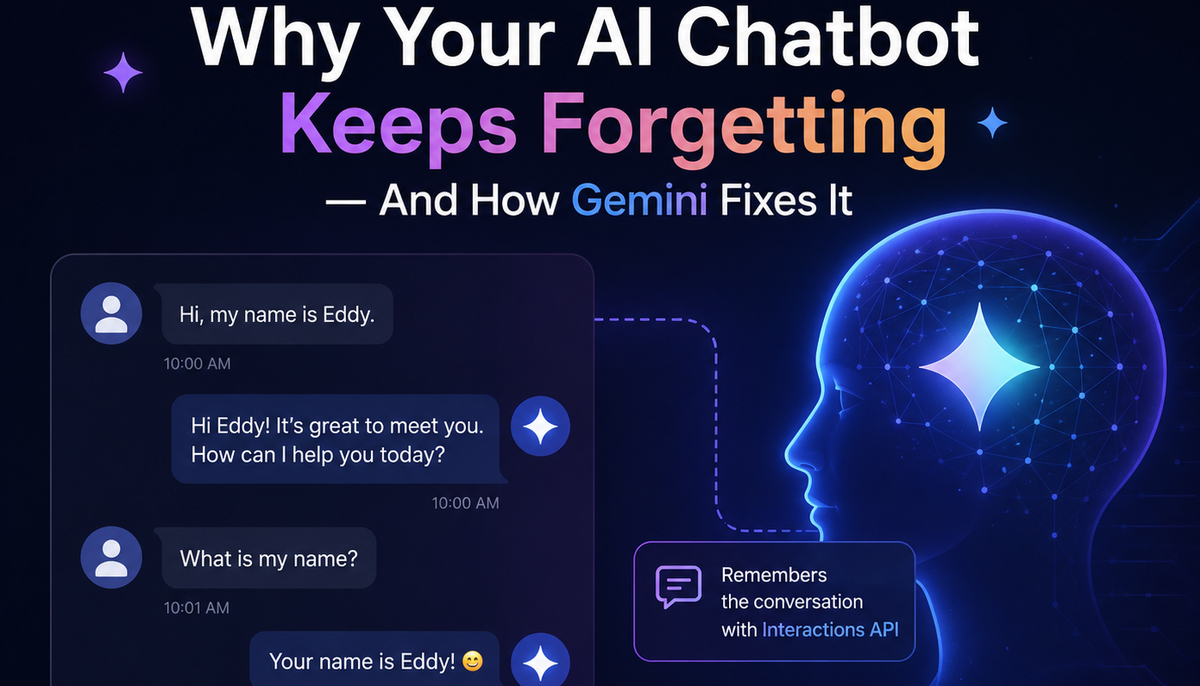
When building an AI chat app, one common problem is memory.
For example:
User: “Hi, my name is Eddy.”
Then later: “What is my name?”
If the AI does not remember the previous message, it may answer:
I don’t know your name yet.
This happens because many AI API requests are stateless. Each request is separate, so the model does not automatically know the previous conversation.
Stateless API: generateContent
generateContent is good for simple one-time requests.
For example:
“Summarise this text.”
“Write an email.”
“Translate this sentence.”
But if you are building a chat app, you usually need to manage conversation history yourself. That means saving messages in your database and sending the previous messages again with each new request.
Stateful API: Interactions API
The new Gemini Interactions API helps with this problem.
Instead of manually sending the full conversation every time, you can send a previous_interaction_id.
Example:
{ "model": "gemini-3.5-flash", "previous_interaction_id": "int_123", "input": "What is my name?"}
Gemini can continue from the previous interaction and understand the context.
So the conversation becomes:
User: “Hi, my name is Eddy.”
AI: “Hi Eddy!”
User: “What is my name?”
AI: “Your name is Eddy.”
Why this matters
For developers, this makes AI chat apps easier to build.
You do not need to manually resend all previous messages every time. The interaction ID works like a conversation pointer. It tells Gemini:
“Continue from this previous conversation.”
This is useful for:
-
- AI assistants
- Customer support bots
- Internal knowledge chat
- Multi-step workflows
- Tool-based AI agents
- Simple explanation
Think of previous_interaction_id like a chat thread ID. Without it, every message is a new conversation. With it, Gemini knows which previous conversation to continue.
Final thought
generateContent is still useful for simple stateless tasks. But for modern AI assistants and agent-style apps, the Interactions API is a better fit because it supports state, tool use, orchestration, and multi-step reasoning.
For AI chat systems, state management is not optional. It is the difference between a chatbot that forgets everything and an assistant that feels natural.